The PCE or Personal Consumption Expenditures Price Index is the preferred gauge of inflation used by the US Federal Reserve Open Market Committee when deciding whether to raise interest rates, lower them, or keep them the same. This index tracks a broader range of expenditures than the CPI or consumer price index which the stock market commonly watches and reacts to. Why is the PCE important for investors? These days the stock market herd mentality results in price swings based on expectations of what the Fed Open Market Committee will do with interest rates. This approach runs contrary to logic if you prefer to use intrinsic value as a guide in buying or selling stocks as it assumes the Fed will always be all powerful. Things look bad for the economy with the threat of a recession and short term investors and traders jump to the conclusion that the Fed will cut rates and that lower rates will fix everything. Of more concern for an investor is that the market has a knee jerk reaction to the CPI, which the FOMC does not prefer as its gauge of how the economy is doing.
What is the PCE Index?
The PCE or Personal Consumption Expenditures Price Index comes from the Bureau of Economic Analysis or BEA. It tracks prices paid by households for services and goods. Compared to the CPI this index covers a broader range of what folks pay for and picks up on how folks change their spending habits to adjust for higher prices. The CPI Index only covers out of pocket payments by urban consumers. The CPE looks at all payments for durable and non-durable goods and services including things paid on behalf of households by employers, like health or other insurance.
How Does the CPE Differ From the CPI?
Over time the CPE commonly shows a lower rate of inflation than CPI although both track inflation and thus rise and fall more or less in parallel. As the graph from the Cleveland Federal Reserve Bank shows, the two indices do not differ widely but they do diverge enough at times to cause different FOMC decisions when following the CPE than if they solely relied on the CPI index.
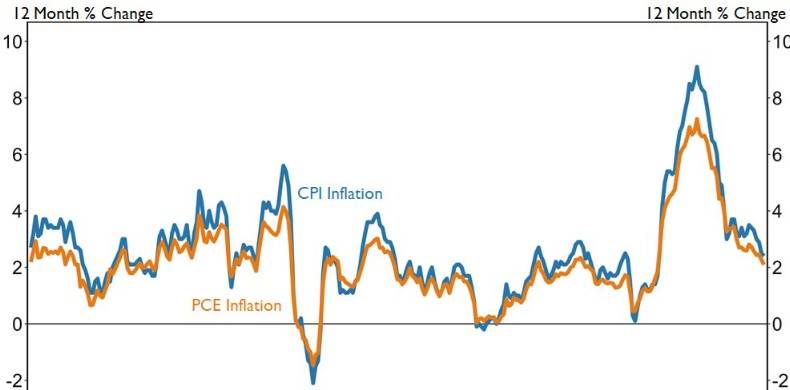
CPE vs CPI 2000 to 2025, Federal Reserve Bank, Cleveland
When Are the CPI and CPE Numbers Released?
The release of the CPI Index by the Bureau of Labor Statistics happens between the tenth and thirteenth of the month, barring any government shutdowns. The CPE Index by the Bureau of Economic Analysis is released during the last week of the month assuming that the government is operating. Thus the CPI hits the news first and tends to drive the market up or down. Assuming that the CPE index is sufficiently different from the CPI its results may well drive the market in the opposite direction from what the CPI did.
How Should An Investor Use the CPE Index in Making Investment Decisions?
Because the CPE Index covers a broader range of consumer expenditures than the CPI it is not surprising that the Fed Open Market Committee prefers is to the CPI in making their decisions. So, it makes sense for an investor to pay more attention to the CPE than the CPI in making their own decisions. Successful long-term investors look at the intrinsic value of their investments. This means analyzing forward-looking earnings and how they affect stock prices going forward. Then the investor compares stock value based on intrinsic value with current market prices. To the degree that these numbers differ significantly an investor using this approach will buy, hold, or sell an investment. Successful long-term use of the CPE index as a tool will require that the investor looks to how the index reflects earnings going forward. This approach differs from the “hall of mirrors” approach used by short-term investors and traders who assume that bad new with the economy as evidenced by an index automatically means good news for the market based on expectations that the FOMC will react in a knee jerk fashion to a rise of fall of the CPI, especially when the CPE will follow in a couple of weeks and may differ sufficiently to lead to a different FOMC decision that what the CPI might have led to!