One of the hardest parts of successful trading isn’t picking direction – it’s understanding where the market really is and where it’s likely to go next. Short-term price moves can feel random, but when you learn to see market structure, you start to see patterns that repeat over time.
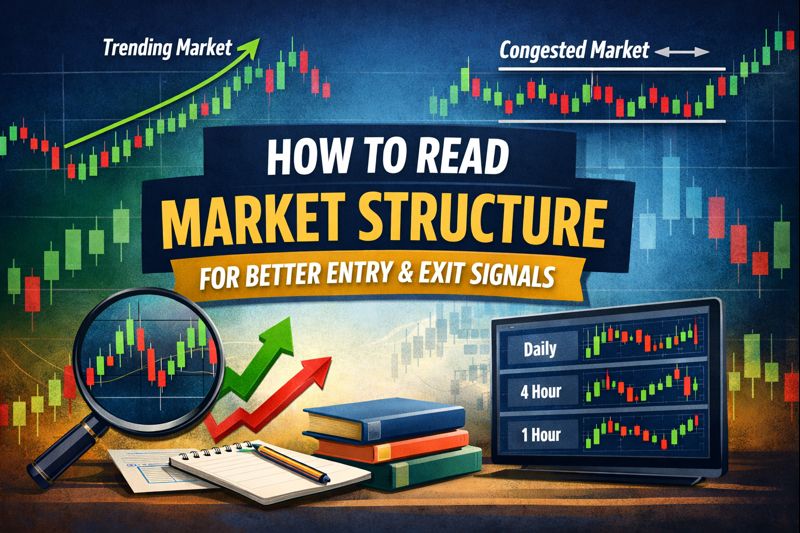
Structure isn’t just support and resistance lines drawn on a chart. It’s about understanding:
- Whether price is trending or congesting
- Where the real supply and demand zones sit
- How institutional players build positions
- How momentum and pullbacks interact
- When to treat a breakout as real versus false
A lot of traders drift from tool to tool – indicators, oscillators, moving averages – without ever tying those tools back into pure structure. The result? Conflicting signals and guesswork.
This article will walk through what structure is, why it matters, and how to combine it with a top-down posture so you trade with the market, not against it.
What Is Market Structure?
At its core, market structure answers this question:
Is the market in a trend or in congestion right now?
A trend is characterized by a sequence of higher highs and higher lows (uptrend) or lower highs and lower lows (downtrend).
Congestion (sideways markets) is where price oscillates in a range, and neither buyers nor sellers dominate.
Understanding whether price is trending or congesting does three things:
- Sets expectations – trends favor continuation strategies; congestion favors range plays.
- Informs risk – trending markets often have defined pullbacks; congestion makes stop placement harder.
- Defines triggers – breakouts matter more in trends; false breakouts are common in congestion.
This simple structural lens filters noise from actual signal.
Trend vs. Congestion: Why It Matters
In a trending market, entries are often taken on pullbacks that respect prior structure.
In congestion, you’re watching the boundaries of the range for signs of institutional accumulation or distribution.
Here’s the thing most traders miss:
The same indicator can give identical readings in trend and range, but the context changes everything.
For example:
- An RSI oversold reading in a strong uptrend can be a buy signal.
- The same reading in a range can lead you into the bottom of a range that continues sideways.
Market structure tells you which is which.
Layering a Top-Down Approach
Structure on a single timeframe gives you context for that timeframe.
A top-down analysis looks at structure across multiple timeframes – for example:
- Daily: trend direction / major range boundaries
- 4-hour: intermediate pullbacks
- 1-hour: execution timing
When all timeframes align (trend direction + no conflicting higher timeframe congestion), your probability stack improves.
Without that alignment, you’re trading against potential unseen resistance or support — exactly where many traders get stopped out.
Putting It Into Practice
A practical workflow might look like this:
- Start with the higher timeframe (e.g., Daily):
Is the market trending or range bound? - Check the intermediate timeframe (e.g., 4H):
Is price respecting structural levels?
Are there signs of trap activity (false breaks)? - Move into execution timeframe (e.g., 1H or 15m):
Look for entries in the direction of the structural bias.
This isn’t guesswork – it’s disciplined structure reading.
Why Structure Outperforms Indicators Alone
Indicators like MACD, RSI, or Stochastics don’t know context – they only measure price action mathematically. Structure is context.
If you trade without structure, you’re essentially trying to trade the output of price instead of the reason price moves.
That’s how novices get whipsawed in ranges and late-entry breakouts.