More and more over the years the world has come to rely on advanced technologies which, in turn, rely on so called rare earth elements. A serious issue for countries outside of China is that China has invested for decades in developing and vertically integrating its mining and processing of rare earth elements and producing powerful magnets and other technologies using these elements. This has progressed to the extent that even with a concerted effort by nations and companies outside of China within the next decade perhaps half of global supply of “light” rare earth elements will come from outside of China. However, supply from outside of China of “heavy” rare earth elements like dysprosium and terbium necessary for the most powerful and advanced magnets will still be only a fifth of global demand while China will still control four fifths of this market. This is a serious issue for the USA, the EU, Japan an other technology dependent economies. Thus there is a big push to develop the wherewithal to make pretty much everyone less dependent on China. Where in this mix are there rare earth element investment opportunities and pitfalls?
Light Versus Heavy Rare Earth Elements
Successful investors know what they are investing in. In the case of rare earth elements there is a clear differentiation between so called “light” and “heavy” members of this group of elements. Light refers to the rare earth elements with atomic numbers of fifty-seven to sixty-three. These elements end up in advanced magnets used in electric vehicles, wind turbines, and computer hard drives (Neodymium and Praseodymium). Additionally, cerium and lanthanum (numbers 57 and 58) are used in petroleum refining (fluid catalytic cracking units). Cerium is also used to polish glass in optical systems. Europium, number 63, is used for LED lights and TV screens and other display technologies. The “light” members of this group are more abundant and easier to refine and process than “heavy” rare earth elements.
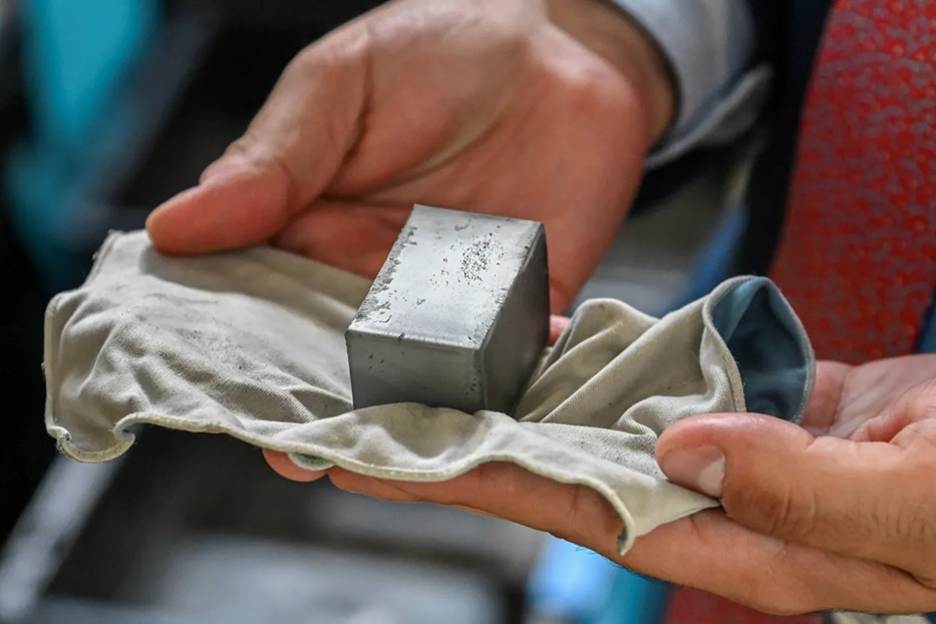
Rare Earth Magnet Courtesy of Bloomberg
Heavy Rare Earth Elements
Heavy rare earth elements have higher atomic numbers than the light members with two exceptions. The “heavy” group ranges from gadolinium, 64, to lutetium, 71, but includes yttrium, 39, and scandium, 21. These elements are rarer than the “light” group, create magnets and other tech products with much better performance at extremely high temperatures and create magnets with superior coercivity which is the ability of a high performance magnet to work within a magnetic field and not become demagnetized. Thus magnets and other tech products derived from heavy rare earth elements are used in the highest tech commercial and military products making them critical for national defense and technological supremacy.
What to Consider When Investing in the Rare Earth Element Realm
Years ago long term successful investor Warren Buffett said that he tended to avoid high tech stocks because changes occurred so quickly. A company that dominated a market niche with a new technology and line of products one year could easily lose their lead and profitability the next due to newly discovered and developed technologies by a competitor. One thing to remain aware of is that scientists are looking for newer ways to create the highest tech products including the use of cheaper “light” rare earth elements instead of more expensive “heavy” rare earth elements. Non Chinese companies to watch in this regard include the following:
- Lynas Rare Earth Limited, Australia
- Proterial, Ltd., Japan
- Arafura Resources Limited, Australia
- Avalon Advanced Materials Inc., Canada
- Alkane Resources Limited, Australia
- Frontier Rare Earths Limited, UK (operations in Namibia
- MP Materials Corp., USA
- Rare Earths Norway,
- LKAB, Sweden
- Leading Edge Materials, Canada (operations in Sweden)
Rare Earth ETFs
Considering that you, as well as most folks, do not have the technological savvy to stay current enough to invest wisely in the rare earth realm, an alternative investment would be an ETF that tracks rare earth stocks. Three that might be worth investigating are URNM, LIT and REMX. REMX or the VanEck Rare Earth and Strategic Metals ETF has a current stock price of $96 a share and has ranged as high as $120 and as low as $34 a share since its inception in 2021. LIT or the Global X Lithium & Battery Tech ETF has a current stock price of $84 a share with a range of $24 to $92 a share over its 16 years of existence. URNM or the Sprott Uranium Miners ETF has a current share price of $60 a share up from its $12 a share opening in 2019 and down from its $75 a share price in January of 2026.
Short Versus Long-Term Rare-Earth Investments
Rare earth minerals will be with us for a long, long time. Technologies will evolve, rise, and fall. To the extent that you like to “play the market,” use technical indicators as your guide and be wary of market hype. For long term investing you will want to research the company or companies that you are interested in using intrinsic value based on forward looking earnings as a guide. That will require more attention and self-education. Those who do this well are likely to be handsomely rewarded for their efforts as the global push to develop more capacity outside of China is not going to go away, ever. For a useful set of insights on how the US and others are working to catch up with China and the details involved, take a look at a recent Bloomberg article about rare earth tensions at the recent summit.